The sport, the palace and Naadam
The rules, the costume, Naadam and the palace
A little background makes the day richer. This is what Wikipedia, UNESCO and the listing say about the sport, the festival and the arena.
The rules
No weight classes, no time limit
Wikipedia says a bökh match has no weight classes, age limits or time limits. A tiny wrestler can face a giant, and a bout lasts until someone falls.
A fall
What ends a bout
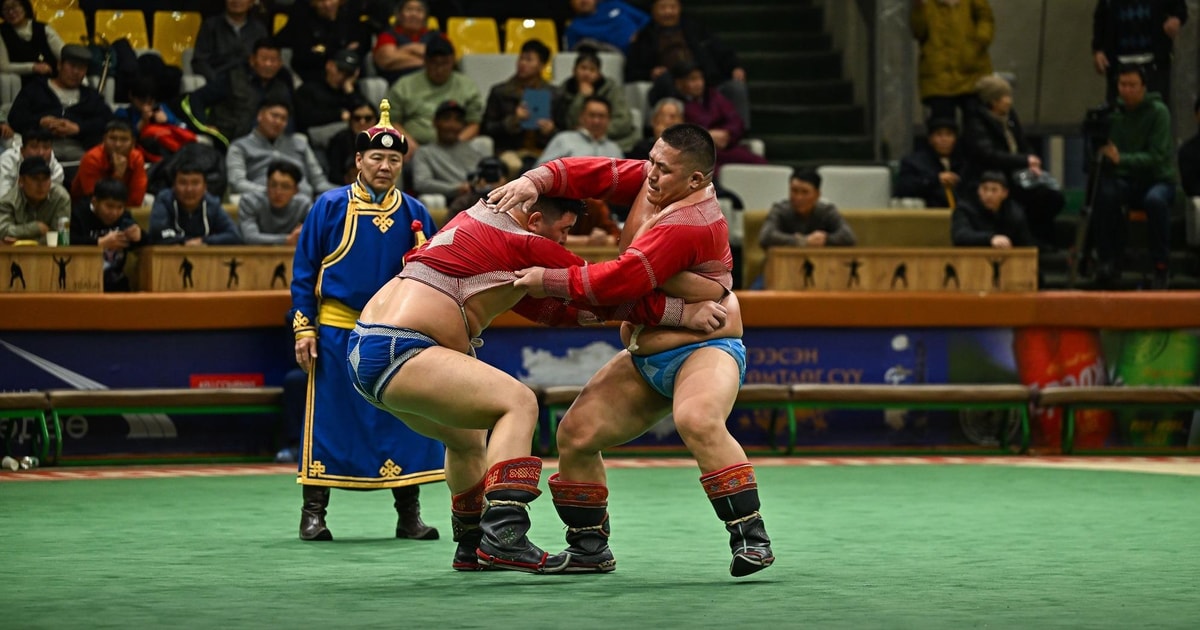
Wikipedia says a wrestler loses by touching the ground with any body part except a foot or a hand. Throws, trips and lifts are used, and striking, choking and locking are banned.
The costume
Zodog, shuudag and gutal
Wikipedia describes the zodog as a tight, collarless, short-sleeved jacket in red or blue, tied at the back, with the front cut away to expose the chest. The shuudag is a pair of small, tight briefs, and the gutal is a leather boot, traditional with slightly upturned toes or Western in style.
The dance
The eagle dance
The listing calls the opening act the eagle dance. Wikipedia calls the dance devee: in Mongolia the wrestler imitates a falcon or phoenix taking off, and the dance is performed on entering and leaving the field. The article adds that it is also a warm-up and cool-down with roots in shamanistic ritual.
Manners
Handshakes and a salute
Wikipedia says opponents shake hands and salute each other and the audience before and after a bout. At the end, one wrestler goes under the other's arm to conclude it formally.
The zasuul
A wrestler's second
Wikipedia describes the zasuul as an on-field guide and encourager who holds the wrestler's hat during the match. In higher rounds a zasuul sings a poetic praise of his wrestler to open a challenge, and the other side's zasuul answers.
Titles
From Falcon to Grand Champion
Wikipedia lists the titles at the Mongolian national Naadam: State Falcon (nachin) for reaching the round of sixteen, then Hawk, Elephant, Garuda and Lion for deeper runs and for winning. Repeat winners become State Champion, Wide Champion and Grand Champion.
Naadam
The three games
UNESCO says Naadam is held every year from 11 to 13 July and centres on three traditional games: horse racing, wrestling and archery. UNESCO recognised it as intangible cultural heritage in 2010, and says winners are rewarded with titles and honoured with ritual praise songs and poems.
Origins
From cave art to the Mongol army
Wikipedia says cave paintings in Bayankhongor Province, dated to around 7000 BC, show two men grappling, and bronze plates from the Xiongnu empire show the art of bökh. It adds that Genghis Khan and later Mongol emperors supported wrestling as military training. The listing traces the sport to the training of Chinggis Khaan's army.
In writing
A famous bout in the Secret History
Wikipedia says The Secret History of the Mongols records a match around the year 1200 between Buri Bökh and Belgutei, in which Belgutei broke Buri's back.
The palace
Bökhiin Örgöö
Wikipedia says Bökhiin Örgöö, meaning Wrestling Palace, is a sports complex in Bayanzurkh District with 2,500 seats and a building in the shape of a yurt. It is the home of Mongolian wrestling competitions and also hosts concerts under a lease.
The year
Tournaments beyond Naadam
Wikipedia says each Lunar New Year 256 wrestlers compete at the palace, with no rank awarded, and that it is considered the second most important tournament after Naadam. It adds that smaller tournaments with 64 or 128 wrestlers are held there in October, November, May and June.
The city
A high, cold capital
Wikipedia gives Ulaanbaatar an elevation of about 1,350 metres and calls it the coldest national capital in the world, with a January average of minus 21.3 degrees Celsius and a July average of 19.0. Most of its rain falls from May to September.
Drawn from Wikipedia's articles on bökh, Naadam, Bökhiin Örgöö and Ulaanbaatar and from UNESCO's entry for Naadam. Listing details were read on 25 November 2026.